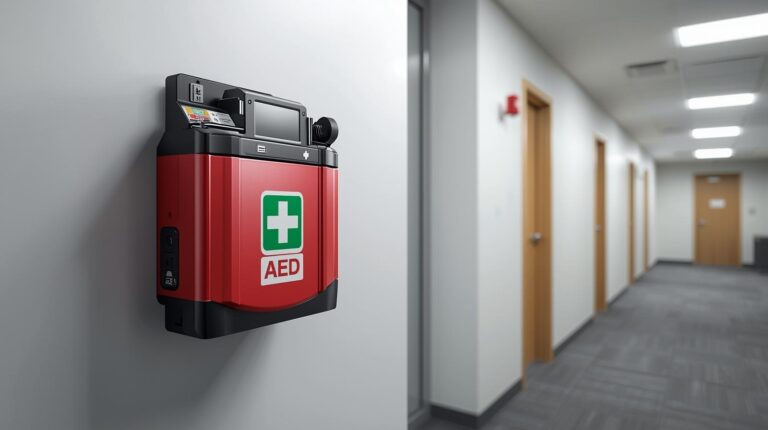
Do employers need an AED, and who is allowed to use one?
In the UK, employers are not legally required to install an Automated External Defibrillator (AED). However, where an AED is provided following a first aid needs assessment, it becomes workplace equipment, and employers have legal responsibilities around its management and use.
Anyone can use an AED in an emergency, and UK law strongly supports life-saving action taken in good faith. This guide explains what UK law, the HSE, and the Resuscitation Council UK actually say — in practical, real-world terms.
1. What UK Common Law Says About Helping in an Emergency
Under English and Welsh Common Law, members of the public are not legally required to intervene in an emergency unless they have created the danger or have a contractual or statutory duty to act.
That said, courts consistently look favourably on people who attempt to help. The Social Action, Responsibility and Heroism (SARAH) Act 2015 reinforces this by requiring courts to consider whether someone was acting responsibly and for the benefit of others.
In major incidents, early aid is often delivered by lay people or off-duty professionals while emergency services wait until a scene is safe. The legal system recognises and supports this reality.
2. Consent in First Aid: When It’s Required (and When It Isn’t)
Consent is a fundamental principle of first aid in the UK.
Informed Consent
If the casualty is conscious, a first aider should explain what they intend to do and obtain permission before providing care.
Implied Consent
If the casualty is unconscious or unable to communicate, the law assumes they would consent to life-saving treatment. This allows immediate intervention and protects the first aider.
3. What the Health and Safety (First Aid) Regulations 1981 Say About AEDs
The Health and Safety (First Aid) Regulations 1981 do not make AEDs mandatory in the workplace. However, where an employer decides, through a first aid needs assessment, to provide an AED, it becomes workplace equipment and therefore falls under health and safety law.
In practical terms, this means employers are expected to ensure that employees are trained to use any equipment they provide, including AEDs, as part of their wider first aid training and emergency preparedness. This is the position reflected in HSE guidance, which then signposts employers to the Resuscitation Council UK as the subject matter expert.
The Resuscitation Council UK advises that while training is strongly recommended, it is not legally mandatory to use an AED. AEDs are specifically designed to be used safely by anyone in an emergency, with clear voice prompts and automated decision-making.
These two positions complement each other:
- Employers should ensure trained first aiders are available in the workplace.
- As part of Emergency First Aid at Work (EFAW) and First Aid at Work (FAW) courses, first aiders are trained and familiarised with AED use.
- If trained staff are unavailable during an emergency, any person can pick up and use an AED without fear of legal consequences.
This approach satisfies health and safety expectations while ensuring that life-saving action is never delayed.
4. Resuscitation Council UK: Legal Risk and AED Use
The Resuscitation Council UK confirms that it is extremely unlikely anyone would be sued for using an AED in good faith. There has never been a successful UK case against someone who attempted to provide first aid.
AEDs are intended for public use, and national guidance actively encourages bystanders to use them when needed.
Could a business be sued for not having an AED?
There is no UK law requiring businesses to install AEDs. While employers must take reasonable safety precautions, there are no known UK cases where a business has been found liable for not providing one.
Could someone be sued for not using an AED?
Only individuals with a defined duty of care, such as designated workplace first aiders, would be expected to act within their training and available equipment.
5. FAQ About AEDs in the Workplace
Do employers legally need a defibrillator?
No. No UK law requires employers to install an AED. However, employers must carry out a first aid needs assessment, and where an AED is provided, it must be managed as workplace equipment under health and safety law.
Do staff need training to use an AED?
AEDs are designed to be used safely by anyone, with clear voice prompts and automated decision-making. While training is strongly recommended, lack of training should never prevent someone from using an AED in an emergency.
Can someone be sued for using an AED?
It is extremely unlikely. UK law and national guidance support people who act in good faith to save a life. There has never been a successful UK case against someone for using an AED in an emergency.
6. AED Training: Who Can Use One?
Anyone can use an AED.
AEDs provide:
- clear voice instructions
- automatic heart rhythm analysis
- guidance on when a shock is required
Training builds confidence and preparedness, but lack of training should never prevent AED use in an emergency.
7. PUWER 1998: Employer Responsibilities When Providing an AED
Where an AED is provided, the Provision and Use of Work Equipment Regulations (PUWER) 1998 apply. Employers must ensure that the AED:
- is suitable for its environment
- is safe and maintained
- is used appropriately
- follows manufacturer instructions
Modern AEDs perform daily self-checks and alert users to faults, making compliance straightforward.
Conclusion: What This Means for UK Employers
AEDs are legally supported, ethically encouraged, and strongly recommended by UK medical authorities. While not mandatory, they significantly improve survival outcomes during cardiac arrest and demonstrate strong workplace safety leadership.
For employers, best practice is clear:
- Carry out a first aid needs assessment
- Ensure trained first aiders are available
- Provide suitable equipment where appropriate
- Allow anyone to act if trained staff are unavailable
AEDs save lives — and UK law supports those who use them responsibly.